
Solving user problems with empathetic solutions


Human-Centered UX Researcher & Product Strategist
I research how people experience products, then turn those insights into design decisions that respect the humans on the other end.
I started my career in the classroom, teaching history and learning how people actually think, not how we assume they think. That instinct carried me into UX research, where I now focus on the places where human behavior meets emerging technology.
My work is rooted in empathetic understanding of how people process, adapt, and sometimes struggle with the tools built for them. The challenges aren't always visible, and the people facing them don't always speak up. Right now, I'm most interested in a question that keeps coming up across every product I touch: how do we build AI experiences and systems that people actually trust?
Every image on this site is mine, shot on a Canon 90D and edited in Lightroom Classic. The photography habit keeps my eye trained on details most people walk past.

These projects shipped. Each one came with real business constraints, real stakeholders, and real outcomes. From developer collaboration at Touro to AI product research at CareerCoachingPro, this work reflects how I practice Human-Centered Design when the stakes are live, and the problems don't have clean edges.
If you're on a desktop, the case studies include embedded interactive prototypes and whiteboards you can explore directly.
Professional Work Portfolio of
UX Case Studies
Synthetic Usability Training Study
Using AI as a preliminary systems test before real human participants touch the product
An AI agent can sound confident and still be wrong, and the people it misleads are the ones who pay for it. Before putting CareerCoachingPro’s intake agent in front of real users, I had to test my own study and set a baseline to measure against.
I designed adversarial synthetic personas to pressure-test the agent, checked every claim it made against the live site, and traced each error back to the instructions that caused it. Across 834 coded claims, pricing hallucinations dropped from 31.3% to 0%. Now real users will be measured against a known baseline instead of a guess.

Human-Centered
AI Framework

AI Agent Product Discovery for CareerCoachingPro
The power of Human-Centered Design
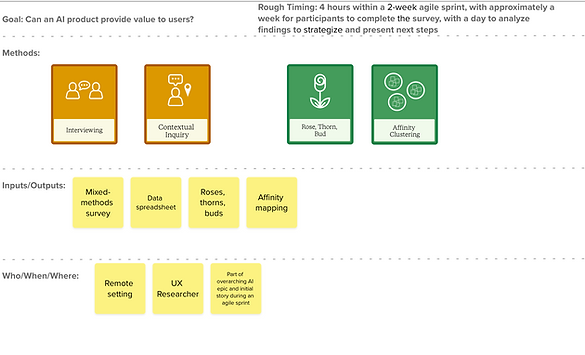
When an early-stage AI product team asked whether an AI networking agent could actually help people, I designed a two-week mixed-methods sprint to find out.
What surfaced wasn't just usability feedback. Participants raised real concerns about trust, transparency, and what it means to practice a deeply human skill with a machine. Those insights reshaped the product direction before a single line of code was written.
This is a shipped research framework on a live product team. The case study walks through the methodology, the trust and ethics themes that emerged, and how Human-Centered Design kept the team focused on the people they were building for.

Touro University New Program Webpage
A chance to apply classroom skills to a live webpage.
This was my first shipped product. The goal was to design an informative experience for prospective students at Touro University's Graduate School of Technology, and it went live. What made this project formative wasn't just the research or the design, it was learning how to collaborate with developers and adjust my work so the build process actually moved. That developer handoff experience taught me that research and design only matter if they can be built, and that shaping your deliverables around the people building them is its own kind of human-centered thinking.

I think in systems and experiences, not screens. Too often in this industry, UI is treated as an aesthetic layer, the visual polish that makes something look finished. When most of us start learning UX, that's where the energy goes: mastering the craft, nailing the heuristics, making things look and feel right. That's a necessary foundation. But the realization that the screen is just one touchpoint in a much larger ecosystem of decisions, behaviors, and needs? That's something many practitioners don't arrive at until years into their careers.
I got there early. Not because I'm smarter, but because I came from a classroom where you can't hide behind the interface. When a lesson isn't working, you see it in real time on a student's face. That forced awareness carried into how I approach design and pushed me past the screen before I ever had a reason to stay there. Honestly, UI was one of the hardest things for me to learn because I don't think in aesthetics. I think in people, problems, and the systems connecting them. That's not a limitation, it's just where my instincts live.
These projects trace that realization taking shape. Burnout was my first project, built on UI instincts before I had the language for what was missing. HobFy is where research revealed that the real problems lived beyond the interface. And Cana is the full expression of that thinking, end-to-end service design in a regulated industry where privacy, systems architecture, and the entire customer journey mattered more than any single screen.
If you're on a desktop, the prototypes are fully interactive. Cana includes a detailed case study report alongside the prototypes.
Personal & Graduate School
UX Case Studies

Multi-Site Healthcare CMS Strategy
A self-directed UX strategy case, real-world constraints from the start
Harborview Regional Health treats people well, then hides itself behind a website that does not. Duplicate pages, mismatched locations, a search bar that will not surface the right doctor. The people who pay for that confusion first are the ones with the least room to absorb it, like a patient navigating cancer who keeps arriving at the wrong location and missing the appointment.
I took this on as a self-directed strategy case, built against a real-world discovery brief. Instead of auditing the patient's journey alone, I mapped five people around it, and the pattern came clear: the broken experience is downstream of a governance problem the patient never sees. One number held the whole story. Of the high-intent users trying to find a doctor, only 22 percent finished.
This is how I have built my work from the beginning, with the real constraints in from the first move. Accessibility as a requirement, a provider directory that syncs on someone else's schedule, search rankings that have to survive a migration, and no budget for a rebuild. The case study walks through the diagnosis, the information architecture I proposed, and a phased roadmap that earns each step instead of promising everything at once.

Cana: A Case Study of UX Research,
Strategy, and Design
Masters Thesis Project
Cana started as a question I couldn't stop thinking about: what does a responsible, end-to-end cannabis experience actually look like when the laws are still being written?
I treated this thesis like a startup problem. The research pushed me past UI into service design, systems thinking, and the privacy architecture required to protect users in a regulated industry. I designed an NFC-based digital ID system, mapped the full customer journey from discovery to purchase, and built interactive prototypes grounded in real regulatory constraints.
What I'm proudest of is the pivot. User testing revealed that the real opportunity wasn't an app. It was a service, one that required thinking about the entire ecosystem around the user, not just the screen in front of them.
Cana shipped as a thesis, and the prototypes were built to the point of dev handoff and collaboration readiness. The concept has room to grow, and the foundation is there for it.
This project is password protected. Reach out directly if you'd like to walk through it together.

HobFy
Making the move from
UI to UX
HobFy was where those instincts started finding structure. When I began interviewing users about how they experience stress across different life stages, the real problems surfaced in places no UI pattern could anticipate. I started connecting the dots between what I'd learned as a teacher, reading a room, understanding how people process new information, meeting them where they are, and what UX research was actually asking me to do.
That experience confirmed what I'd been feeling since Burnout and drove me to learn User-Centered Design on my own. From this point forward, every project carried the same question: who is the person using this, what are they actually going through, and how do we design around that reality, not our assumptions?
Burnout: The Car Finding App
My First Project

This is where it started. A friend told me about a problem he and his crew were running into within Southern California car culture, and I wanted to design something that could help. The course focused on UI design principles, clean layouts, heuristics, visual craft. But as I worked through it, I kept noticing something the curriculum wasn't addressing. UX was being completely ignored. We were building art pieces, not solutions. I had a real person with a real problem sitting across from me, and nothing in the coursework was pushing us to understand what he actually needed.
What I didn't realize at the time was that I was already practicing Human-Computer Interaction without a formal structure to call it that. Years of teaching had trained me to watch how people engage with what's in front of them, to notice when something isn't clicking, and to adjust before frustration sets in. I was bringing that same instinct to design without knowing it had a name. That observation is what drives my approach to products, services, and experiences today: the interface is never the whole story.